Variable Annuities: Strategies to Help Counter Retirement Risks
You might have the foresight and enough excess income to take full advantage of the tax breaks associated with IRAs, employer-sponsored retirement plans, and health savings accounts. Still, these tax-deferred accounts are subject to strict annual contribution limits, so it may not be possible to save enough money in them to maintain your current lifestyle through 20 to 30 years of retirement — or longer.

However, there are no federal contribution limits for variable annuities, which are insurance contracts that offer the potential for growth because a portion of the premium is invested in the financial markets, and investment gains won’t be taxed until withdrawals are made. The annuity’s future value and income payments will largely be determined by the performance of investment subaccounts that you select.
Guaranteed living benefits are optional riders that can be attached to a variable annuity for an additional cost. Here’s how they might be used to address two worrisome retirement risks.
1. Outliving your savings
You can set up a lifetime income stream from your annuity in one of two ways: annuitization or withdrawals. When a contract is annuitized, the cash value is converted into a series of periodic income payments based primarily on current interest rates (or market-based returns) and your life expectancy. Control of the account transfers to the insurance company, so you no longer have access to the investment principal.
With an optional guaranteed lifetime withdrawal benefit (GLWB), you can withdraw a minimum amount of income from a variable annuity for life without having to annuitize, even if the original account value is depleted. If the markets perform well, the income amount could increase, but it typically cannot decrease unless you take a withdrawal that exceeds the guaranteed withdrawal amount. The remaining account value may be available for other purposes and inherited by your designated beneficiaries after your death.
2. Paying for long-term care
Adding a long-term care (LTC) rider to a variable annuity might help prevent your savings from being depleted by escalating costs. Benefits are typically triggered if you are diagnosed with dementia or are unable to perform two or more activities of daily living, such as eating, bathing, and dressing. If care is needed, the payout is increased for a specified period or until the account value reaches zero. And if you never need care, you can continue to earn a return on your money. Medical underwriting requirements tend to be more lenient with an LTC rider than with a standalone policy, and you don’t have to worry about future rate increases or the issuer canceling the policy.
A variable annuity is a long-term investment product designed for retirement purposes. Variable annuities that come with living benefits tend to have more limited investment options. The investment return and principal value of the investment options are not guaranteed and may fluctuate with changes in market conditions. When the annuity is surrendered or annuitized, the principal may be worth more or less than the original amount invested. Withdrawals reduce annuity contract (living and death) benefits and values. Withdrawals of annuity earnings are taxed as ordinary income and may be subject to surrender charges plus a 10% federal tax penalty if made prior to age 59½.
Should You Count on Living Longer?
With advances in medical care lengthening life expectancies, the U.S. Census Bureau projects that the number of centenarians will quadruple over the next several decades.
Estimated number of Americans ages 100 and older (in thousands)
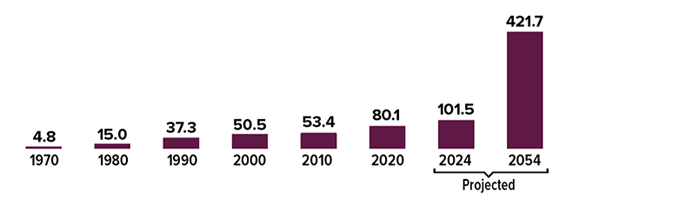
Source: Pew Research, 2024
Annuity guarantees are contingent on the financial strength and claims-paying ability of the issuing insurance company. Annuities are not guaranteed by the FDIC or any other government agency. They are not deposits of, nor are they guaranteed or endorsed by, any bank or savings association. Annuities typically have contract limitations, fees, and charges, which can include mortality and expense charges, account fees, investment management fees, administrative fees, charges for optional benefits, holding periods, termination provisions, and terms for keeping the contract in force.
Variable annuities are sold by prospectus. Please consider the investment objectives, risks, charges, and expenses carefully before investing. The prospectus, which contains this and other information about the variable annuity contract and the underlying investment options, can be obtained from your financial professional. Be sure to read the prospectus carefully before deciding whether to invest.